

The AI Revolution: How Artificial Intelligence Is Reshaping the Job Market

Published in: Technology, Future of Work | Reading time: 7 minutes
Artificial intelligence is no longer a distant concept confined to science fiction. It is here, it is growing, and it is fundamentally changing the way we work. From customer service chatbots to AI-driven medical diagnostics, the technology is advancing faster than most of us anticipated — and the job market is feeling every tremor.
But what does this really mean for workers today? Is AI a threat, an opportunity, or both? In this post, we explore the nuanced reality of AI’s impact on employment — who’s at risk, who’s thriving, and what every professional needs to know to stay ahead.
The Scale of Disruption: Numbers Don’t Lie
The statistics are striking. According to the World Economic Forum’s Future of Jobs Report, an estimated 85 million jobs may be displaced by automation and AI by 2025 — yet the same report projects the creation of 97 million new roles suited to the new division of labor between humans and machines.
McKinsey Global Institute estimates that up to 30% of tasks in approximately 60% of all occupations could be automated with current technology. That doesn’t mean 30% of jobs disappear overnight — but it does mean the nature of nearly every role is being transformed.
“The question is not whether AI will change your job. The question is whether you’ll be ready when it does.”
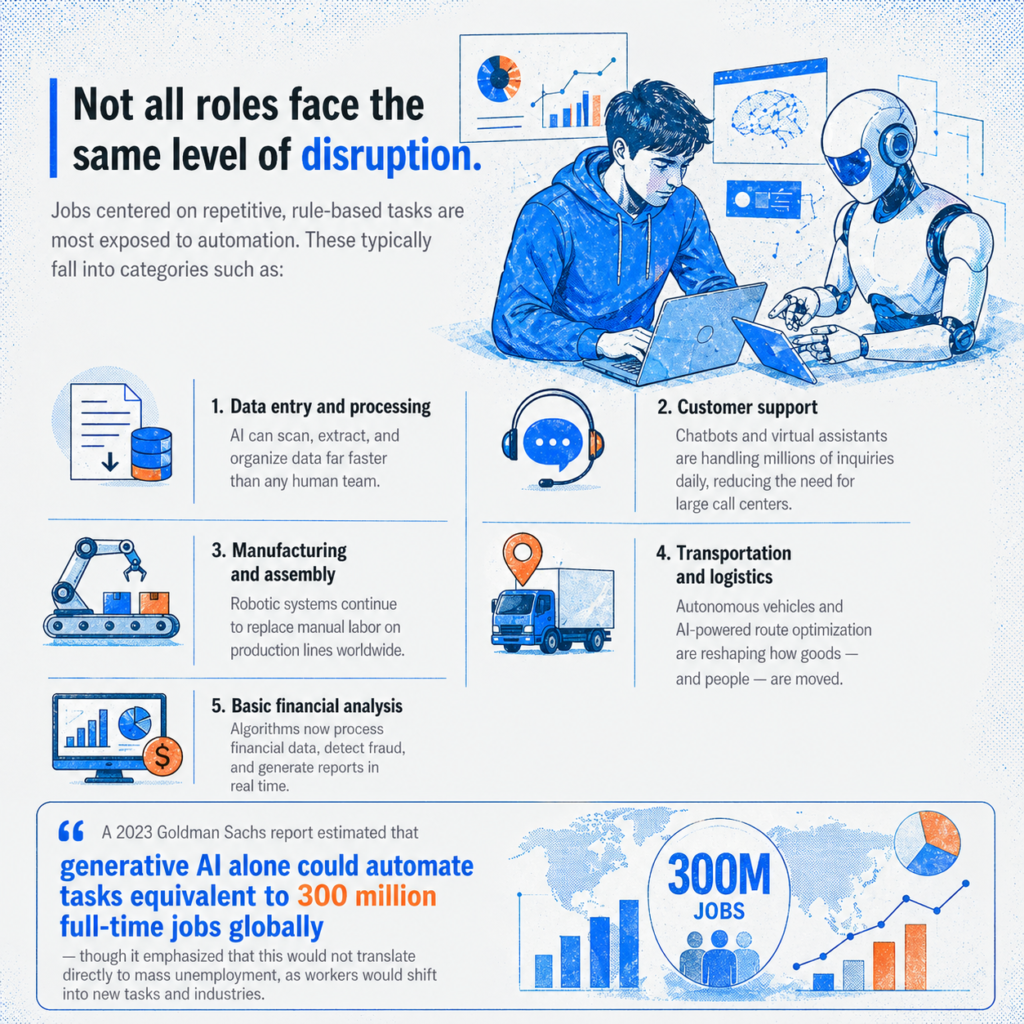
Which Jobs Are Most Vulnerable?
Which Jobs Are Growing?
While some roles shrink, others are expanding rapidly. The rise of AI is creating enormous demand for professionals who can build, manage, and work alongside intelligent systems. The fastest-growing careers in the AI era include:
- AI and Machine Learning Engineers — Designing and training the models that power modern AI applications.
- Data Scientists and Analysts — Interpreting the vast datasets that AI systems depend on.
- AI Ethics Officers — Ensuring that AI systems are used fairly, transparently, and responsibly.
- Prompt Engineers — Crafting inputs that maximize the effectiveness of large language models.
- Cybersecurity Specialists — Protecting AI systems and the sensitive data they process.
- Healthcare AI Specialists — Bridging the gap between medical expertise and AI-driven diagnostics.
Beyond these tech-specific roles, AI is elevating the value of distinctly human skills — empathy, leadership, creative problem-solving, and ethical judgment — that machines cannot replicate.
The “Augmentation” Opportunity
Perhaps the most important — and underreported — story of AI in the workplace is not replacement, but augmentation. In many fields, AI is making workers significantly more productive rather than making them redundant.
Consider a few examples:
- A lawyer who once spent days reviewing contracts can now use AI to complete the same task in hours, freeing time for strategic advice and client relationships.
- A graphic designer using generative AI tools can iterate through dozens of creative concepts in the time it previously took to develop one.
- A software developer aided by AI code assistants can write, test, and debug code at speeds that were unimaginable just three years ago.
The World Economic Forum found that workers who learn to collaborate effectively with AI tools tend to be more productive, earn higher wages, and experience greater job satisfaction than those who resist or ignore the technology.
The Skills Gap: A Growing Crisis
One of the most urgent challenges of the AI era is the widening skills gap. As technology evolves faster than educational systems can adapt, millions of workers are being left without the skills they need to remain competitive.
A LinkedIn Workforce Report found that AI-related skills are growing at a rate faster than any other category — yet fewer than 1 in 5 workers report having received any AI literacy training from their employer. This gap disproportionately affects:
- Older workers with established but potentially obsolete skill sets
- Workers in low-wage, task-intensive industries
- Professionals in regions with limited access to digital education
Addressing this gap is not just a personal responsibility — it requires coordinated action from governments, corporations, and educational institutions. Countries like Singapore, Germany, and Canada have already launched national reskilling initiatives; many others are just beginning to catch up.
What Workers Can Do Right Now
The good news is that the AI transformation is not happening overnight. Workers have a window of opportunity — but only if they act. Here are practical steps every professional should take:
- Develop AI fluency. You don’t need to become a programmer, but understanding how AI tools work in your industry gives you a significant competitive edge.
- Lean into your humanity. Cultivate skills that AI cannot replicate — empathy, negotiation, creative leadership, moral reasoning, and nuanced communication.
- Embrace continuous learning. Platforms like Coursera, LinkedIn Learning, and Google Career Certificates offer accessible, affordable AI and tech training for all skill levels.
- Adapt your role proactively. Identify which parts of your current job could be augmented or automated, and position yourself as the person who orchestrates and adds judgment to those processes.
- Build your professional network. In a rapidly shifting job market, relationships and reputation matter more than ever.
The Bigger Picture: An Evolving Social Contract
AI’s impact on employment also raises deeper questions about how society is organized. If AI drives significant productivity gains, who benefits? Will workers share in the prosperity, or will the gains flow disproportionately to capital owners and technology companies?
Policymakers around the world are debating measures such as:
- Universal basic income (UBI) pilot programs to cushion workers displaced by automation
- AI taxation frameworks that channel productivity gains back into workforce transition programs
- Stronger labor protections to prevent exploitative uses of algorithmic management
- Mandatory reskilling programs funded by corporations that deploy large-scale automation
These are not simple questions with easy answers, and reasonable people disagree about the right approach. But the conversation is essential, and every worker, business, and citizen has a stake in the outcome.
Conclusion: Adapt, Don’t Fear
History has a consistent pattern: every major technological revolution — from the printing press to the industrial revolution to the internet — has disrupted existing jobs while ultimately creating more opportunity than it destroyed. AI is almost certainly following the same arc.
The workers who will thrive in the AI era are not those who fear the technology or those who blindly trust it — they are those who understand it, engage with it critically, and use it to amplify their uniquely human capabilities.
The future of work is not human versus machine. It is human and machine — a partnership that, if navigated wisely, could unlock levels of productivity, creativity, and well-being that past generations could only dream of.
The question is not whether AI will change your career. It will. The question is whether you’ll be ready to rise with it.
About the Author
This article was written to inform professionals navigating the rapidly evolving AI landscape. For more insights on technology, the future of work, and digital transformation, subscribe to our newsletter.
Tags: Artificial Intelligence, Future of Work, Job Market, Automation, Reskilling, Technology, Career Development

Responses