

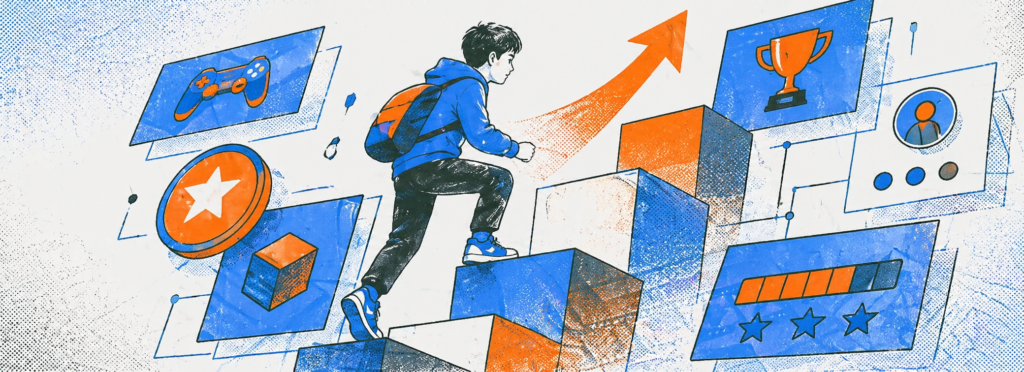
Level Up Learning: How Gamification Is Transforming eLearning

Published in: eLearning, Instructional Design, EdTech | Reading time: 8 minutes
Imagine finishing an online training module and actually wanting to start the next one. Picture learners voluntarily logging back in, not because they have to, but because they’re three achievements away from unlocking the next level. That’s not a fantasy — it’s what well-executed gamification looks like in eLearning.
Gamification is one of the most powerful and widely discussed trends in modern education and corporate training. But it’s also one of the most misunderstood. Slapping a badge on a quiz is not gamification. True gamification is a thoughtful design strategy rooted in psychology, motivation science, and instructional design.
In this post, we’ll break down what gamification really means, why it works, how to implement it effectively, and what pitfalls to avoid.
What Is Gamification in eLearning?
Gamification is the application of game design elements and mechanics to non-game contexts — in this case, learning environments. It’s important to distinguish gamification from two related but different concepts:
- Gamification — Adding game-like features (points, badges, leaderboards, progress bars) to existing learning content.
- Game-based learning — Using actual games as the primary vehicle for learning (e.g., simulations, educational video games).
- Serious games — Purpose-built games designed entirely around educational or training objectives.
All three have value, but gamification is the most accessible and scalable approach for most eLearning designers and corporate training teams. It enhances existing content rather than replacing it with a game.
The Science Behind Why It Works
Gamification isn’t just a trend — it’s grounded in decades of research on human motivation, behavior, and cognition. Several key psychological principles explain its effectiveness:
1. Dopamine and the Reward Loop
Every time a learner earns a badge, completes a level, or sees their score climb, their brain releases dopamine — the neurotransmitter associated with pleasure and motivation. This creates a powerful reward loop that encourages continued engagement.
2. Self-Determination Theory
Psychologists Edward Deci and Richard Ryan identified three core human needs that drive intrinsic motivation: autonomy (the sense of control), competence (the feeling of mastery), and relatedness (connection to others). Gamification, when done well, addresses all three.
3. Flow State
Positive psychologist Mihaly Csikszentmihalyi described “flow” as the optimal state of engagement — where challenge and skill are perfectly matched. Gamified learning environments, with their adaptive difficulty levels and immediate feedback, are uniquely designed to help learners find and sustain this state.
4. Spaced Repetition and Active Recall
Many gamified platforms naturally incorporate spaced repetition (reviewing content at increasing intervals) and active recall (testing knowledge rather than passively reviewing). These techniques dramatically improve long-term retention — and gamification makes them feel less like work.
Key Gamification Elements in eLearning
Not all gamification elements are created equal. Here’s a breakdown of the most impactful mechanics and how to use them effectively:
Points and Scoring Systems
Points provide instant feedback on performance and create a tangible measure of progress. They work best when tied to meaningful actions — answering correctly, helping peers, or applying knowledge to scenarios — not just clicking through slides.
Badges and Achievements
Badges serve as digital credentials that recognize specific accomplishments. The most effective badges are meaningful (tied to genuine achievement), visible (shareable on profiles), and occasionally surprising — hidden “Easter egg” badges reward exploration and curiosity.
Leaderboards
Leaderboards introduce social competition and can be highly motivating — but global leaderboards can demotivate lower-performing learners. Cohort-based or time-limited leaderboards (e.g., “top learners this week in your department”) are generally more effective and inclusive.
Progress Bars and Level Systems
Visual progress indicators trigger the “completion drive” — humans are wired to finish what they’ve started. A simple progress bar showing “75% complete” is often enough to keep a learner going. Level systems add a sense of journey and mastery over time.
Challenges and Quests
Structuring content as challenges, missions, or quests gives learners a narrative framework that makes the journey feel purposeful. Instead of “Module 3: Compliance Training,” you get “Mission 3: Safeguard the Organization.” It’s a subtle but psychologically powerful reframe.
Immediate Feedback
Games give players instant feedback on every action. eLearning should do the same. Rather than waiting until the end of a module to reveal a score, gamified platforms provide real-time responses that reinforce learning in the moment it happens.
Storytelling and Narrative
The most immersive gamified learning experiences are built around a story. A cybersecurity training becomes a spy thriller. A sales training becomes a client relationship simulator. Narrative context transforms abstract concepts into emotionally engaging scenarios that are far more memorable.
Real-World Results: What the Data Says
- TalentLMS reports that 89% of employees say they would be more productive if their work were more game-like, and 83% feel more motivated when training includes gamification elements.
- A study by the University of Colorado found that gamified learners scored 14% higher on skill-based assessments and 11% higher on factual knowledge tests.
- Deloitte reported that gamification reduced the time needed to complete a leadership training program by 50% while improving engagement scores significantly.
- Duolingo reports that daily active users spend an average of 34 minutes per day on the app voluntarily — far exceeding most corporate eLearning benchmarks.
“Gamification, at its best, is not about making learning fun. It’s about making learning irresistible.”
Common Mistakes to Avoid
Mistake 1: Gamifying for the Sake of It
Adding badges and points to content that hasn’t been designed with clear learning objectives is putting a game skin on a bad course. Gamification enhances good instructional design — it doesn’t replace it.
Mistake 2: Overloading on Extrinsic Rewards
Over-reliance on external rewards can undermine intrinsic motivation — the “overjustification effect.” If learners only engage to collect badges and points, they’ll disengage the moment those incentives disappear. Use extrinsic rewards to spark engagement while the content itself builds genuine interest.
Mistake 3: Ignoring Learner Diversity
Not all learners respond equally to competitive mechanics. Great gamification offers multiple pathways to success — collaborative challenges alongside competitive ones, mastery recognition alongside speed rewards.
Mistake 4: Neglecting Mobile Experience
More than 70% of eLearning is accessed on mobile devices. Gamification elements must be designed for small screens from the start — not retrofitted from a desktop experience.
How to Get Started: A Practical Framework
- Define your learning objectives first. Every gamification element should serve your learning goals, not the other way around.
- Know your learners. What motivates them? Are they competitive, collaborative, achievement-oriented, or exploration-driven?
- Start small. Begin with a single course — add a progress bar, restructure content as missions, introduce a weekly leaderboard. Measure and iterate.
- Measure and refine. Track not just completion rates, but time-on-task, quiz performance, and voluntary re-engagement. Use the data to improve.
The Future of Gamification in eLearning
- AI-powered adaptive gamification — Systems that automatically adjust difficulty, narrative, and rewards based on individual learner performance.
- Augmented and virtual reality — Immersive environments that blur the line between simulation and game.
- Social and collaborative mechanics — Team quests, peer-teaching rewards, and community challenges that leverage social learning.
- Blockchain-verified credentials — Digital badges backed by blockchain that carry real-world professional weight.
Conclusion: The Game Has Changed
We live in an era of unprecedented competition for human attention. Streaming services, social media, and video games have raised the bar for what “engaging content” means — and traditional eLearning, with its click-through slides and end-of-module quizzes, is struggling to compete.
Gamification offers eLearning designers a proven, research-backed strategy to reclaim learner attention, deepen engagement, and improve outcomes. The best learning doesn’t feel like learning at all. It feels like a challenge worth taking on, a story worth completing, a level worth reaching.
The game has changed. Is your learning strategy ready to keep up?
About the Author
This article is written for eLearning professionals, instructional designers, and L&D leaders seeking to deepen learner engagement through evidence-based design strategies. Subscribe for more resources on gamification, instructional design, and EdTech trends.
Tags: Gamification, eLearning, Instructional Design, EdTech, Corporate Training, Learning & Development, Employee Engagement, LMS

Responses